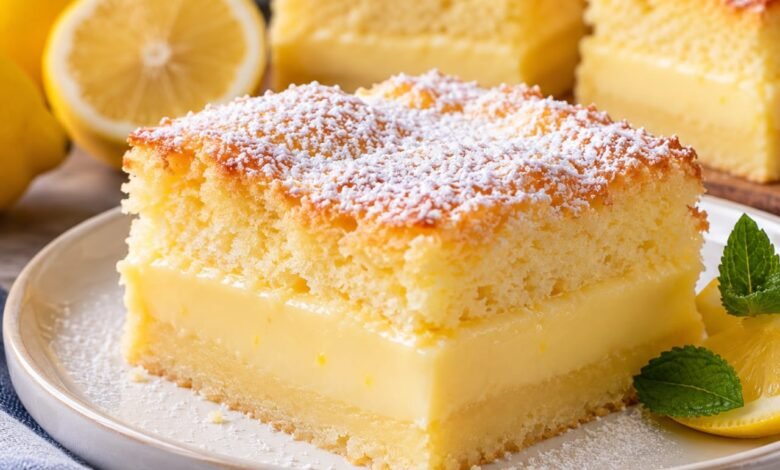
Looking for a lemon dessert that feels special without making three separate batters? This Magic Lemon Cake is a bright, citrusy treat made from one simple mixture that can separate in the oven into three delicious layers: a light sponge topping, a creamy lemon custard center, and a soft, dense base.
Fresh lemon juice and finely grated lemon zest give every bite a refreshing flavor. The secret is in the thin batter, properly whipped egg whites, gentle folding, and slow baking. After cooling and chilling, the cake becomes easier to slice and its layers become more noticeable.
Important: This is a traditional version made with eggs, butter, and milk, so it is vegetarian but not vegan.
What Is Magic Lemon Cake?
Magic Lemon Cake is a variation of the classic magic custard cake. Instead of preparing separate cake and custard mixtures, you combine the ingredients into one thin batter. During baking, the different components form distinct textures.
The top becomes light and sponge-like, the middle develops a creamy custard texture, and the bottom forms a soft, denser layer. The exact separation depends on the ingredient ratios, mixing technique, oven temperature, and cooling time.
Why You’ll Love This Magic Lemon Cake
- Three textures in one cake: Enjoy a soft sponge top, creamy middle, and delicate bottom layer.
- Fresh lemon flavor: Lemon zest and juice add a bright, tangy taste.
- Simple ingredients: You can make it with common baking ingredients.
- Great make-ahead dessert: The cake needs time to cool and chill, making it convenient to prepare in advance.
- Beautiful presentation: A light dusting of powdered sugar makes each slice look elegant.
Magic Lemon Cake Ingredients
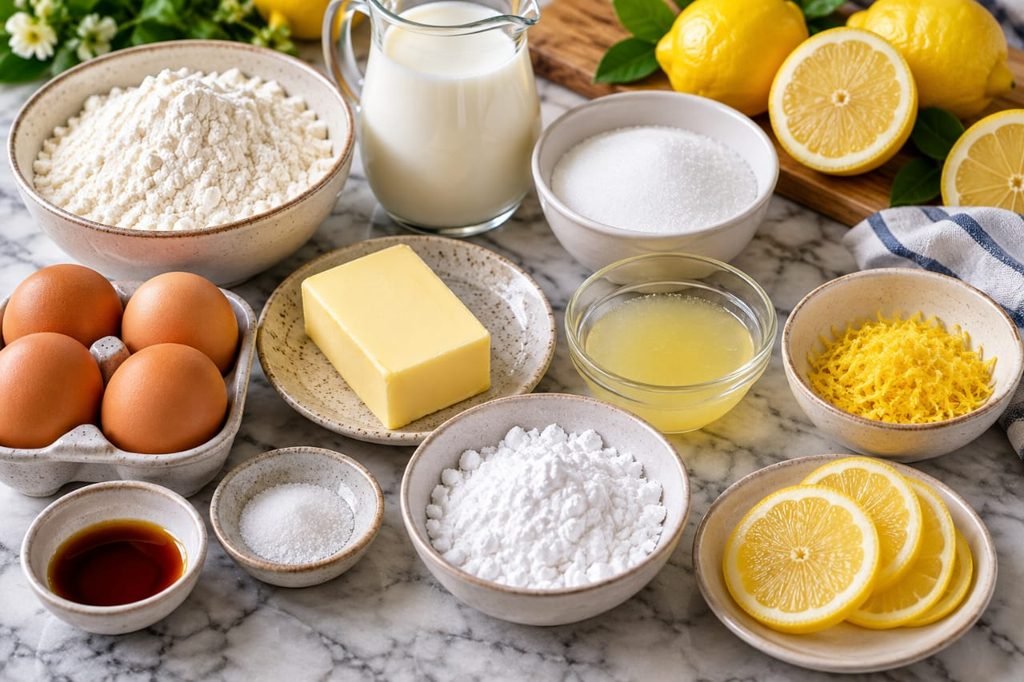
Measure the ingredients carefully. Because this cake depends on a delicate balance between liquid and structure, changing the quantities significantly may affect how the layers form.
- 4 large eggs, separated: The yolks enrich the batter, while the whipped whites help create the light upper layer.
- 3/4 cup granulated sugar (150 g): Sweetens the cake and helps the egg yolks become pale and fluffy.
- 1/2 cup unsalted butter (113 g), melted and cooled: Adds richness and a tender texture.
- 3/4 cup all-purpose flour (about 95–100 g): Provides structure.
- 1 3/4 cups whole milk (420 ml), lukewarm: Creates the thin batter that allows the layers to develop.
- 1/4 cup fresh lemon juice (60 ml): Adds a bright citrus flavor.
- Zest of 1 medium lemon: Gives the cake a fragrant lemon aroma.
- 1 teaspoon vanilla extract: Softens the sharpness of the lemon.
- Powdered sugar, for serving: Optional, for a simple finish.
Equipment You’ll Need
- One 8-inch square baking pan (20 x 20 cm)
- Two clean mixing bowls
- An electric mixer or hand whisk
- A fine grater or zester
- A flexible spatula
- A fine-mesh sieve for the powdered sugar
How to Make Magic Lemon Cake Step by Step
Step 1: Prepare the Oven and Pan
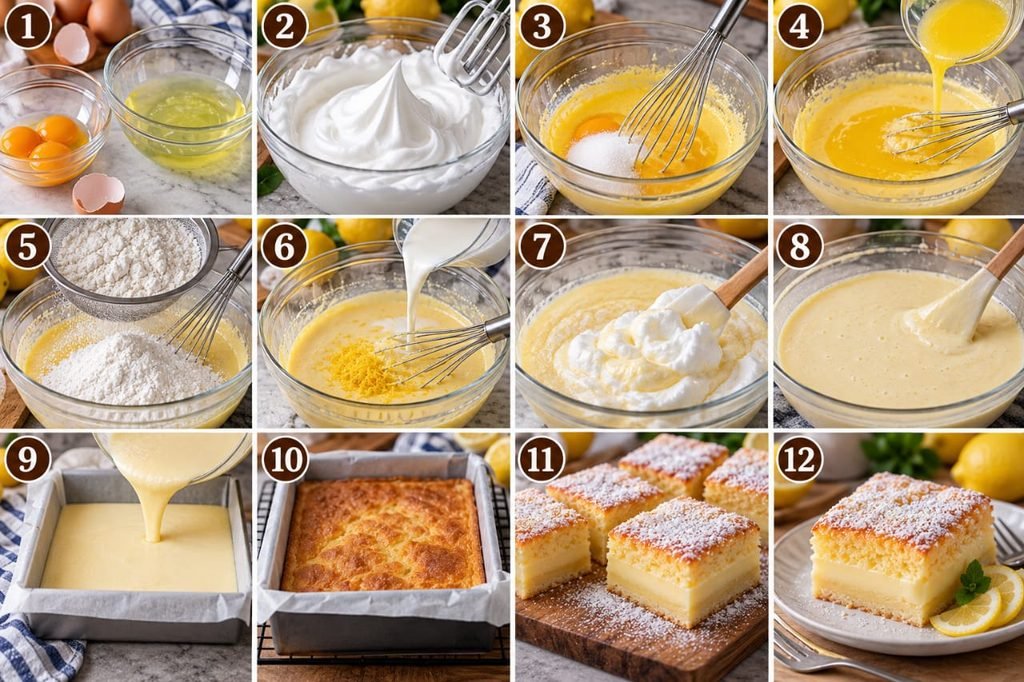
Preheat the oven to 325°F (160°C). Line an 8-inch square baking pan with parchment paper, leaving a little overhang on two sides to help lift out the cooled cake. Lightly grease the exposed sides if needed.
Separate the eggs carefully, placing the yolks in one bowl and the whites in another. Make sure the bowl for the whites is clean and free of grease.
Step 2: Whip the Egg Whites
Beat the egg whites with an electric mixer until stiff peaks form. When you lift the beaters, the peaks should hold their shape without looking dry or grainy.
Set the whites aside while you prepare the yolk mixture. Avoid letting any egg yolk get into the whites, as fat can prevent them from whipping properly.
Step 3: Mix the Egg Yolks and Sugar
In a separate bowl, beat the egg yolks and granulated sugar until the mixture becomes pale, thick, and creamy. This usually takes about 3–5 minutes with an electric mixer.
Add the melted butter, which should be cooled rather than hot, and the vanilla extract. Mix until combined.
Step 4: Add the Flour and Lemon
Sift the flour into the yolk mixture and mix gently until incorporated. Add the fresh lemon juice and finely grated lemon zest.
Slowly pour in the lukewarm milk while mixing on low speed. The batter will be much thinner than ordinary cake batter. This is expected for magic cake, so do not add extra flour just to thicken it.
Step 5: Fold in the Whipped Egg Whites
Add the whipped egg whites in three additions. Use a spatula to fold gently from the bottom of the bowl toward the top.
Do not beat the mixture until completely smooth. A few small, soft white pieces may remain. The goal is to distribute the egg whites without losing all the air that helps form the sponge layer.
Step 6: Bake the Cake
Pour the thin batter into the prepared pan and carefully transfer it to the oven. Bake at 325°F (160°C) for approximately 45–60 minutes, checking the cake toward the end of the baking time.
The top should be lightly golden and set, while the center may retain a slight, gentle wobble. It should not look completely liquid. Baking time varies with the pan, oven, and batter, so use the visual signs as well as the clock.
Step 7: Cool Completely
Remove the pan from the oven and let the cake cool in the pan on a wire rack. Once it reaches room temperature, cover it and refrigerate it for at least 2 hours, or until the custard layer has set enough for clean slices.
Do not rush this step. Cutting the cake while it is warm can cause the soft middle to collapse or smear.
Step 8: Slice and Serve
Use the parchment paper to lift the chilled cake from the pan. Cut it into squares with a sharp knife, wiping the blade between cuts if necessary.
Dust lightly with powdered sugar just before serving. For extra freshness, serve with a few fresh berries or a thin twist of lemon zest.
Tips for Getting Three Distinct Layers
- Use the correct pan size: An 8-inch square pan gives the batter a suitable depth. A much larger pan can change the baking time and layer thickness.
- Measure accurately: Too much flour can make the cake heavy, while too much liquid may prevent the custard from setting properly.
- Use lukewarm milk: Very cold milk can cause the melted butter to firm up and make the mixture harder to combine.
- Whip the egg whites properly: Stiff peaks help create the lighter upper layer.
- Fold gently: Avoid vigorous mixing after adding the whites.
- Keep the oven temperature steady: Avoid opening the oven repeatedly during the first part of baking.
- Allow enough cooling time: The custard becomes firmer as the cake cools and chills.
Common Magic Lemon Cake Problems
Why Did My Cake Form Only Two Layers?
Sometimes the custard and base layers are not sharply separated. This can happen because of variations in mixing, ingredient measurements, oven temperature, or baking time. The cake may still taste delicious, even if the layers are less distinct.
Why Is My Cake Too Runny?
The cake may need more baking time, or it may not have cooled and chilled long enough. Check that the center is no longer liquid before removing it from the oven, and refrigerate the cake until the custard sets.
Why Is the Top Layer Flat?
The egg whites may not have reached stiff peaks, or they may have lost too much air during folding. Use a clean bowl and fold the whites in gently with a spatula.
Why Is the Cake Rubbery or Dense?
Overmixing, inaccurate flour measurements, or excessive baking can affect the texture. Measure the flour carefully and remove the cake when the center is set with only a slight wobble.
Variations to Try
- Extra lemon flavor: Add a little more finely grated lemon zest, keeping the liquid quantities unchanged.
- Vanilla lemon cake: Keep the vanilla extract for a softer, rounder flavor.
- Berry topping: Serve chilled slices with fresh raspberries or blueberries.
- Powdered sugar finish: Keep the topping simple to let the three layers stand out.
How to Store Magic Lemon Cake
Because this cake contains eggs and milk and has a custard-like center, store it covered in the refrigerator. For best quality, enjoy it within 3 days. Do not leave it at room temperature for more than 2 hours.
For the best texture, serve it chilled or allow an individual slice to stand at room temperature briefly before serving. Freezing may change the texture of the custard after thawing.
Frequently Asked Questions
Does Magic Lemon Cake really make three layers?
It can form three distinct textures during baking: a dense bottom, a creamy custard center, and a light sponge top. Results can vary depending on the ingredients, technique, and oven.
Is Magic Lemon Cake the same as lemon cake?
No. Traditional lemon cake is usually a more uniform sponge or butter cake. Magic Lemon Cake has a much thinner batter and a custard-like middle that develops during baking.
Can I use bottled lemon juice?
Fresh lemon juice is recommended for its brighter flavor. Bottled juice can be used in a pinch, but it may taste different. Fresh zest adds an important part of the lemon aroma.
Can I make this cake ahead of time?
Yes. Prepare it a day ahead and refrigerate it after it cools. Chilling helps the custard set and makes the cake easier to cut neatly.
Can I make Magic Lemon Cake without separating the eggs?
Separating the eggs is important for this version because the whipped whites help create the light upper layer. Skipping this step may change the texture and reduce the separation of the layers.
Is Magic Lemon Cake vegan?
No. This version contains eggs, butter, and dairy milk. It is suitable for vegetarians who eat dairy and eggs, but it is not suitable for a vegan diet.
Final Thoughts
Magic Lemon Cake is a lovely choice when you want a dessert with fresh citrus flavor and contrasting textures. Its thin batter and gentle baking process help create a soft sponge topping, a creamy middle, and a delicate base in one pan.
Take your time with the egg whites and cooling process, measure carefully, and let the cake chill before slicing. Serve it cold with a light dusting of powdered sugar for a simple, refreshing dessert.