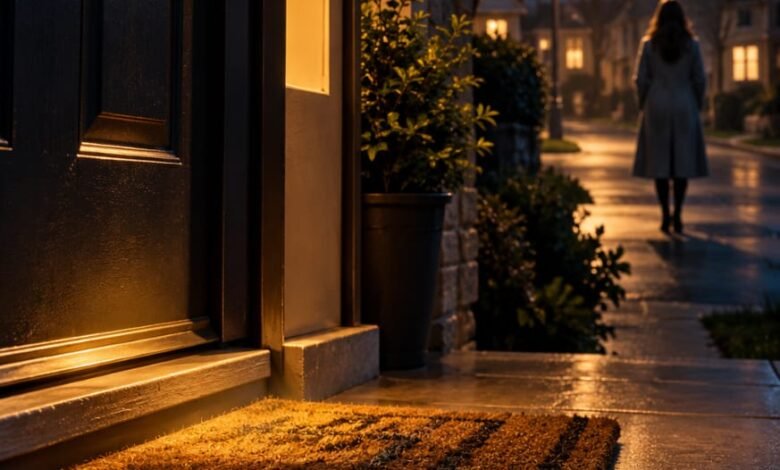
The first note appeared on a Sunday morning in October.
It was folded twice and tucked carefully beneath my doormat, as if whoever left it didn’t want the wind to carry it away.
I found it when I stepped outside to get the newspaper.
The newspaper was still inside its plastic sleeve, damp with morning dew.
The note wasn’t.
That was the first thing that bothered me.
The second was the handwriting.
Small.
Precise.
Almost old-fashioned.
I unfolded the paper.
There were only five words.
You forgot to lock your window.
I stood on the porch and read it three times.
Then I went back inside.
Every window in the house was locked.
I checked them twice.
Then a third time.
Nothing was wrong.
I told myself it was a prank.
Maybe a neighbor had noticed the window from outside. Maybe someone had mistaken my house for another.
I threw the note into the trash.
By Sunday evening, I had almost forgotten about it.
Almost.
The Blue Mug
The second note appeared exactly seven days later.
Same place.
Same folded paper.
Same handwriting.
This time, it said:
Your blue mug is still in the kitchen.
I stopped breathing for a moment.
The blue mug.
I hadn’t thought about it in years.
It was an ugly little ceramic mug with a chipped rim and a faded blue color. My mother had given it to me when I moved into my first apartment.
She had wrapped it in newspaper and put a twenty-dollar bill inside.
“For emergencies,” she had said.
I had spent the money on pizza two days later.
The mug, however, had stayed with me.
Four apartments.
Two relationships.
One divorce.
It had survived everything.
Now it sat on the top shelf of my kitchen cabinet.
Almost nobody knew about it.
My mother had died three years earlier.
My ex-wife knew about it, but we hadn’t spoken in almost two years.
I walked into the kitchen.
The mug was exactly where it had always been.
I took it down.
There was a tiny crack near the handle that I remembered making when I was twenty-three.
I turned it over.
Nothing.
I checked the doors.
Locked.
Windows.
Locked.
I looked at the security camera I’d installed after the first note.
The footage showed nobody approaching my front door that morning.
That made things worse.
Someone knew about the mug.
And apparently, they knew how to avoid my camera.
The Notes Continue
The notes continued throughout November.
Each Sunday.
Always underneath the doormat.
Always written in the same handwriting.
Your upstairs neighbor works night shifts now.
True.
I had never told anyone.
The following week:
The lock on your back gate sticks when it’s cold.
Also true.
Then:
You should water the plant on your windowsill.
I looked at the plant.
The leaves were already beginning to turn brown.
I watered it immediately.
The notes weren’t threatening.
That was what made them so unsettling.
Whoever was leaving them didn’t seem interested in hurting me.
They seemed interested in proving that they knew me.
I started changing my routine.
I stopped leaving for work at the same time.
I parked in different places.
I checked the camera every morning.
Nothing.
No stranger.
No suspicious car.
No explanation.
Then, one Sunday morning, the message changed.
Don’t take the usual road to work tomorrow.
I stared at it for a long time.
This time, I felt something I hadn’t felt before.
Fear.
The Road
The next morning, I ignored the note.
I wish I could say I had a good reason.
The truth was simpler.
I was tired of being controlled by a stranger.
I’d taken the same road to work for almost six years.
I wasn’t going to let a piece of paper change my life.
So I drove my usual route.
Seven minutes later, I saw the brake lights.
Cars were stopped as far as I could see.
A delivery truck had overturned on the overpass ahead.
Police officers were blocking the road.
I looked at the clock.
7:48 a.m.
According to the news later that evening, the truck had overturned at 7:42.
I had left my house at 7:35.
I sat behind the steering wheel, staring at the accident.
My hands felt cold.
The note had been waiting for me the day before.
Someone had known.
But how?
The Woman Across the Street
That night, I watched the security footage again.
Nothing.
Then I noticed something.
At 2:13 a.m., a shadow appeared near the edge of the camera’s view.
It remained there for almost thirty seconds.
Then it disappeared.
I enlarged the image.
A woman.
She was wearing a long gray coat.
Her face wasn’t visible.
I looked through my bedroom window.
Across the street, underneath an old oak tree, stood the same woman.
She was looking directly at my house.
I opened the front door.
She turned.
For a second, our eyes met.
Then she walked away.
I stepped onto the sidewalk.
“Wait!”
She didn’t stop.
I followed her around the corner.
Nothing.
She was gone.
No car.
No footsteps.
Nothing.
Only an empty street.
The Photograph
The following Sunday morning, there was no note.
For the first time in weeks, the space beneath my doormat was empty.
I felt strangely disappointed.
Then I walked into the kitchen.
The blue mug was sitting on the table.
There was coffee inside it.
Fresh coffee.
Still warm.
Beside it was an old photograph.
I knew the photograph immediately.
I hadn’t seen it since I was a child.
It showed me at about six years old.
I was standing beside my mother in front of a house I barely remembered.
My mother was smiling.
And beside her was a young woman.
Tall.
Dark hair.
Same eyes as my mother.
I stared at the photograph.
Something about her face felt familiar.
I turned it over.
There was writing on the back.
The handwriting was the same.
You used to call me Auntie June.
I sat down.
A memory appeared.
Not a complete memory.
Just a sound.
A woman’s voice.
Laughter.
A red bicycle.
A summer afternoon.
And someone saying:
“Don’t forget me.”
I couldn’t remember anything else.
What My Father Told Me
I called my father.
He answered after several rings.
“Do you remember Auntie June?” I asked.
There was silence.
Then he said:
“Where did you hear that name?”
“Who was she?”
Another silence.
“Your mother’s younger sister.”
I looked at the photograph.
“Where is she now?”
My father sighed.
“She left when you were little.”
“Why?”
“There was an argument between her and your mother.”
“About what?”
“Family things. Money. Pride. Things people say when they’re angry.”
“Did she die?”
My father didn’t answer immediately.
Finally, he said:
“No.”
I froze.
“You told me she died.”
“I never said that.”
“Then why haven’t I ever heard about her?”
“Because your mother didn’t want you to.”
I looked again at the woman in the photograph.
“Why?”
My father sighed.
“June made mistakes. But your mother was angry with her for years. Eventually, they stopped speaking.”
I felt a strange mixture of anger and confusion.
“Where is she now?”
“I don’t know.”
“Are you sure?”
“Your mother received a letter from her about fifteen years ago. After that, nothing.”
I hung up.
For the first time, I wondered whether the woman across the street was Auntie June.
The Letter
That evening, I searched through my mother’s old belongings.
Boxes.
Photographs.
Letters.
Things I hadn’t touched since her death.
After almost an hour, I found a small wooden box hidden beneath some old clothes.
Inside was a single envelope.
My mother’s handwriting was on the front.
June — if you ever come back.
My hands shook as I opened it.
Inside was a letter.
It wasn’t angry.
It was sad.
My mother wrote about the argument.
She wrote that she regretted the last words she had said to June.
She wrote that she had tried to find her.
And then I read something that stopped me.
He still remembers you, even if he doesn’t know that he does.
I read the sentence again.
Then again.
My mother had been talking about me.
She had known that someday I might remember.
The Final Sunday
The following Sunday, I woke before sunrise.
I didn’t check underneath the doormat.
I already knew there would be a note.
At 7:10 a.m., I heard a soft knock.
I opened the door.
The woman in the gray coat stood there.
For a moment, neither of us spoke.
She looked older than she had in the photograph.
But there was no doubt.
It was her.
“Auntie June?”
Her eyes filled with tears.
She nodded.
“I wondered if you’d remember.”
I looked at her for a long moment.
“I remember the bicycle.”
She smiled.
“You hated that bicycle.”
“I loved that bicycle.”
“You crashed it into your mother’s flower bed.”
I laughed.
She laughed too.
And suddenly, a memory came rushing back.
Her holding my hand.
My mother standing behind us.
Summer sunlight.
A blue mug sitting on a table.
I remembered her voice.
Don’t forget me.
“I thought you were gone,” I whispered.
“I was.”
“Why did you come back?”
She looked down.
“Because your mother died.”
Her voice broke.
“I wanted to say goodbye. But I was too afraid.”
I didn’t know what to say.
She reached into her coat and handed me a final piece of paper.
I unfolded it.
There were only four words.
I never forgot you.
The Last Secret
We sat on the porch for almost an hour.
June told me everything.
She hadn’t been watching me to frighten me.
She had been afraid to knock on my door.
She had seen me from across the street several times but couldn’t find the courage to approach.
So she left notes.
The first one about the window was simply meant to let me know she could see me.
The second was about the blue mug because she remembered giving it to my mother.
The warning about the road was genuine.
She had seen the accident on the news before I left for work.
The rest were little reminders.
Things she remembered about me.
Things she hoped would unlock the memories of a childhood I had almost completely forgotten.
Before she left, I asked her one question.
“Why didn’t Mom tell me about you?”
June looked toward the street.
“Because sometimes people spend so many years protecting themselves from an old wound that they forget someone else is growing up around it.”
Then she stood.
“Will I see you again?”
She smiled.
“If you want me to.”
She walked away.
This time, I didn’t follow her.
I didn’t need to.
The Blue Mug
June and I stayed in touch after that.
She told me stories about my mother that I had never heard.
Stories about their childhood.
Stories about the house in the photograph.
Stories about me when I was too young to remember.
And every Sunday morning, I still checked underneath my doormat.
Not because I expected another warning.
Because I liked knowing that something unexpected might be waiting there.
One Sunday, months later, I found a small piece of paper.
The handwriting was familiar.
I opened it.
There were only three words.
Coffee next Sunday?
I smiled.
Then I looked at the blue mug sitting beside me.
For the first time in years, I filled it with coffee.
And I waited.
I thought I had finally uncovered the truth. Then, the following Sunday, another note appeared under my door.
This time, it contained only four words: “You are not alone.”